Custom machines. Built faster. Paying back sooner.

Levra designs, builds, programs, and commissions automation cells and stations for manufacturers that don’t carry a large automation team. Because we build on proven hardware patterns and a reusable controls foundation, we get from concept to a running machine faster than a traditional integrator — and the sooner the machine runs, the sooner the payback starts.

Bring us the bottleneck, not a perfect spec · Reply within one business day

Rotary disk stamper — pick, index, stamp, eject Shop demonstrator
5 days
Spec to running demo on our most recent in-house build — work that normally takes two to three weeks
3 machines
Designed, built and programmed in-house
7 years
Founder’s prior experience — medical device, robotics & factory automation
One team
Mechanical, controls, HMI & commissioning

How a project starts

Two ways in. A price you approve before anything gets built.

Where you start depends on whether the machine is already defined. Both routes end with a scope and a price you approve before work begins — fixed-price when the scope is defined, capped cost-plus when it is still uncertain, so you are never signing a blank check.

You know what you want built

Budgetary proposal: no cost
  1. Share the application Send the machine concept, throughput goals, layout, and photos or video of the work area.
  2. Review the budgetary proposal If the requirements are defined enough to quote responsibly, the budgetary proposal costs nothing and carries no obligation. It covers mechanical design, controls, HMI, timeline, and price.
  3. If it needs work to quote, we say so Projects that need layouts, cycle-time validation, or component selection before anyone could quote honestly start with a short paid feasibility phase — and that cost credits toward the build if you award it.
Send the specs →

Once a proposal is approved

Both paths run the same build process.

Four stages, in the order the machine and the money actually move.

  1. Design & build

    Mechanical, controls, and HMI developed as one integrated system in our shop.

    Output: drawings, panel, working cell
  2. Factory acceptance test

    Run against agreed cycle time, quality, uptime, and safety criteria before shipment.

    Output: signed FAT protocol
  3. Install & site acceptance

    Installed, commissioned, and validated against the same criteria on your floor.

    Output: signed SAT protocol
  4. Handover & support

    Documentation, training, and backups delivered. Optional support for later improvements.

    Output: the ownership package

Scroll for all four stages →

Why our machines come together faster

The repeatable work is already built and debugged.

Hardware patterns, a parts workflow, and a controls software foundation carry from one machine to the next. The engineering hours on your project go into what is actually unique about your machine — the fixtures, the motion, the sequence.

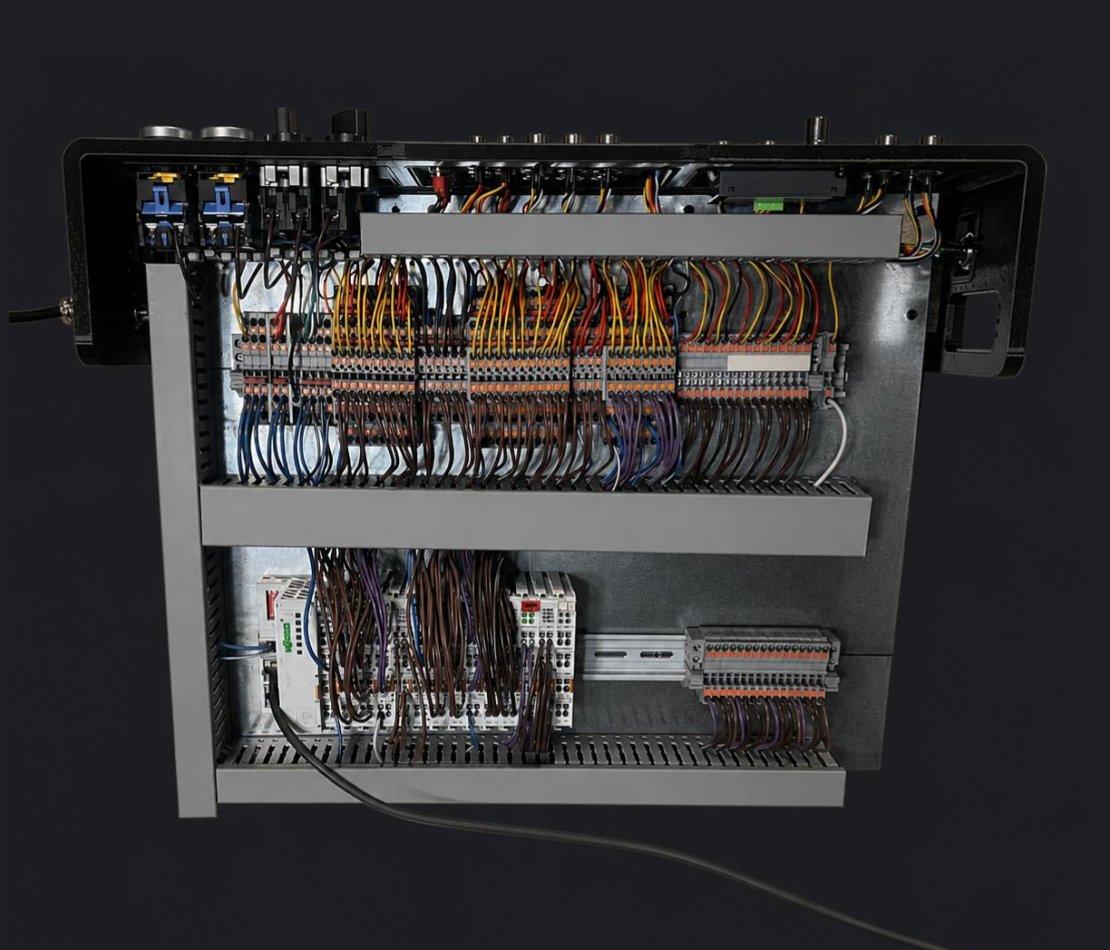
Levra controls brick: PLC, I/O and communication modules on DIN rail
Controls brickWago 750-352

Proven hardware patterns

Power, controls, motion, and pneumatic modules are proven on the bench, then packaged into a custom industrial panel with only the parts your machine needs. Fewer procurement surprises, no new compatibility problems at integration.

See the four bricks →
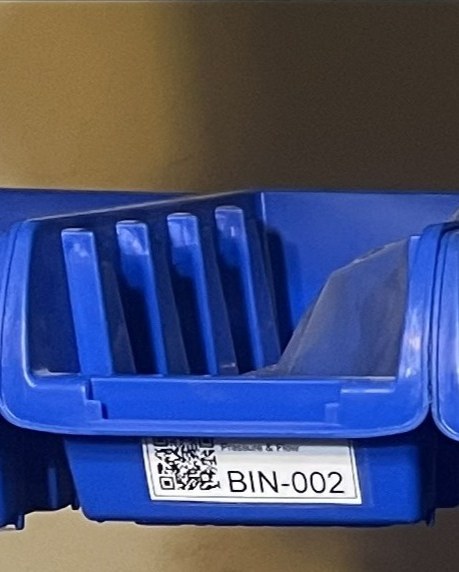
Barcoded Levra hardware inventory bin
Hardware inventoryBIN-002

Parts pulled before assembly

Every component is barcoded and tied to a project, so the complete kit is on the bench before the build starts. Gaps show up before assembly stalls, and a spec change comes back as a list of affected parts and a cost delta.

See the parts workflow →
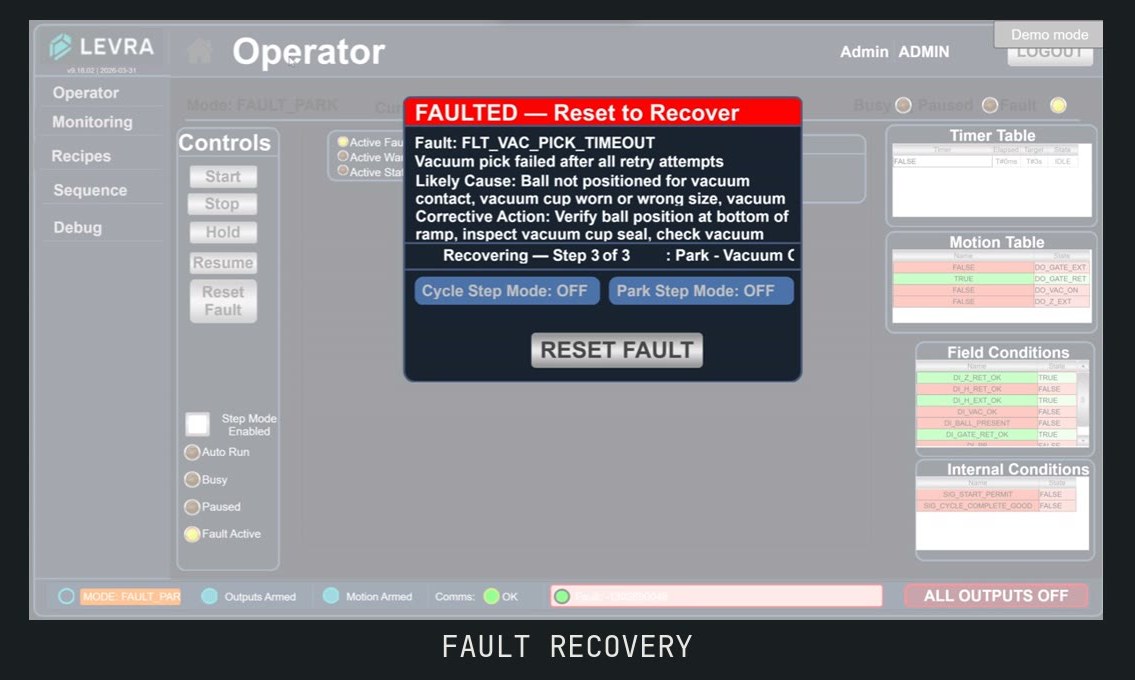
CODESYS HMI fault recovery screen with code, cause and corrective action
CODESYS templateStructured recovery

One operator experience

Mode management, fault recovery, job tracking, diagnostics, login, and manual control ship from the same software foundation. Every machine presents the same controls, so training carries from one cell to the next instead of starting over.

Review the template →

One cycle, at your pace

Inspect the motion, one step at a time.

This is the rotary disk stamper running on our floor. Scroll to move the machine through a full cycle and stop wherever you want a closer look — the same way you would walk a cell before signing for it.

  1. PickVacuum picker lifts a single disk from the stacked magazine.
  2. IndexRotary stage carries the disk to the stamping position.
  3. StampPneumatic head cycles against sensed home and stamp positions.
  4. EjectFinished part is ejected and the stage indexes back to pick.

Scroll to drive the cycle

Proof of work

Machines running, with the build details left visible.

Three machines built end to end on our own floor. They run as demonstrators rather than customer installations, which is exactly why we can show you every part of them.

Full cycle: pick, index, stamp, ejectShop footage
Demonstrator

Rotary disk stamper

Rotary index · vacuum pick · pneumatic stamp · magazine reload · CODESYS

Picks single disks from a stacked magazine, indexes them to a stamping station, and ejects finished parts. Operators reload the magazine and keep the cell running without engineering involvement.

Build notes →
Classify, crush, dischargeShop footage
Demonstrator

Can crusher with classification

Geometry classification · 5/3 paired valve control · guard interlock · per-job telemetry

Classifies a loaded can by geometry (standard 12oz, tall, or invalid) and crushes only valid cans. The discharge waits for the guard, the crush waits for classification, and every cycle is auditable.

Build notes →
Pick, place, retry, resumeShop footage
Demonstrator

Pick-and-place cell

Vacuum pick with retry · operator hold · resume from interrupted step

Built to show recovery behavior with real hardware. When retries exhaust, the machine faults; after Reset the cycle resumes from the exact step it stopped on, not from the beginning.

Build notes →

What you own at handover

The machine is yours, not a dependency on us.

Documentation is a deliverable tied to acceptance, not something assembled afterward if there is time. Your maintenance team, an outside contractor, or a different integrator can pick up a Levra machine and work on it.

Every item below is handed over as part of the project. You receive the complete CODESYS project and HMI source for your machine with a perpetual licence to run, maintain, and modify it — there is no lockout and nothing is withheld to keep you calling us.

Bill of materials
Complete BOM with part numbers.
Electrical prints
Panel drawings and field wiring that match what was actually built.
I/O map
Every input and output named, addressed, and documented.
PLC & HMI source
The CODESYS project and HMI files for your machine, plus backups, with a perpetual licence to run, maintain, and modify them.
O&M documentation
Operating and maintenance basics for the people who run the machine.
FAT / SAT protocols
Acceptance criteria agreed before the build, signed before and after install.
Training
Operators and maintenance staff trained on the machine before we leave.
The shop behind the machine

Discipline in the shop is what makes a schedule real.

Barcoded parts, kitted builds, and standard panel patterns are not housekeeping. They are how we protect a delivery date, and how a mid-build change comes back as a number instead of an argument.

Where we fit

Who this works best for

Small & midsize plants
Manufacturers without a large in-house automation team — most often 50 to 300 employees, though the process decides the fit, not the headcount.
Operator bottlenecks
Manual handling, counting, or inspection holding back otherwise good equipment.
Equipment needing help around it
Better handling, counting, or staging upstream and downstream of machines you already run.
Teams that own their equipment
People who care about documentation, training, and maintaining the cell long term.

After go-live

Support and continuity

Trained on your side first
Operators and maintenance staff are trained before we leave, so day-to-day operation never depends on us.
You hold the source
Program backups and project files are delivered at handover, so any qualified contractor can service the machine.
Standardized controls
Every machine shares the same structure and diagnostics, so troubleshooting is not a reverse-engineering exercise.
Optional ongoing support
Support packages and hour packs for improvements after go-live.

Before you ask anyone for a quote

Pressure-test the payback yourself.

Our free calculator combines labor, throughput, quality, materials, downtime, and changeover into one payback number, and refuses to double-count them. Your numbers stay in your browser — nothing is sent anywhere unless you choose to email yourself the report.

Open the ROI calculator

Show us the process that’s slowing your floor down.

Photos, a short video, a throughput number, and the pain point in one sentence are enough to start. We’ll tell you what fits, what needs discovery, and what should stay manual for now.